
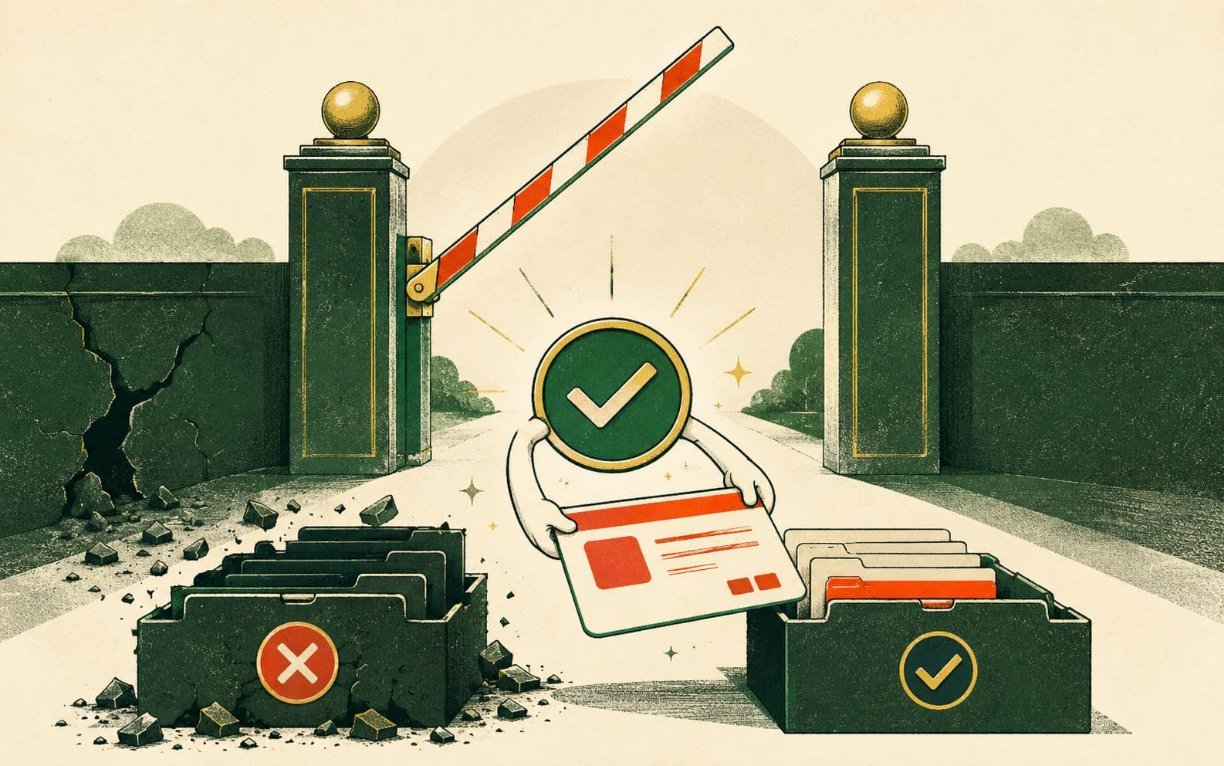
What is the TMF / MATCH list?
The TMF (Terminated Merchant File), also known as the MATCH list (Member Alert to Control High-Risk Merchants), is a global database maintained by Mastercard that holds information about merchants whose payment-processing accounts have been terminated by acquiring banks or processors.
Critical impact
Being placed on the TMF / MATCH list makes processing extremely difficult. Once listed, opening new merchant accounts is hard — though not impossible — for a minimum of five years.
TMF vs MATCH: what's the difference?
There is no functional difference. The terms are used interchangeably:
- TMF (Terminated Merchant File) — the original name used by processors and acquirers.
- MATCH list — Mastercard's official branding for the same database.
Both refer to the exact same system. Visa, American Express, Discover and other card networks also check this database when evaluating merchant applications, even though it is maintained by Mastercard.
How do merchants get added to the list?
Processors and acquiring banks can add a merchant to the MATCH list when terminating an account for specific violations. There are 13 official reason codes:
Official MATCH reason codes
How long does a TMF listing last?
Once added to the MATCH list, your information remains for:
- A minimum of five years from the date of listing.
- Some violations (such as a fraud conviction) can remain longer.
- A listing can only be removed by the acquiring bank that added you — and they rarely do.
Industry reality
While the official minimum is five years, in practice most processors automatically reject TMF merchants regardless of how long it's been. Specialists like MIDs have access to acquiring banks that individually review MATCH-listed merchants.
How to check if you're on the list
There are several ways to verify your MATCH-list status:
- Contact your previous processor — they're required to notify you in writing if they add you to the MATCH list.
- Apply for a merchant account — new processors check the MATCH list during underwriting and will tell you if you're listed.
- Work with a payment consultant — a partner like MIDs can check on your behalf without reporting the inquiry.
- Official MATCH inquiry — request a copy of your MATCH file through a registered acquiring bank.
Can you get off the list?
Removal is rare, but here are the only legitimate paths — and the things that don't work:
- Listed in error (prove it with documentation).
- Identity theft (police report plus evidence).
- The original acquirer agrees to remove it (very rare).
- Wait five-plus years for automatic expiration.
- "TMF removal services" — usually scams.
- Paying fines or chargebacks — doesn't remove the listing.
- Creating a new entity — principals are tracked.
- Offshore accounts — MATCH is global.
How to get processing if you're on the list
While mainstream processors and aggregators automatically reject TMF merchants, specialists can still help. Here's how.
1. Work with TMF-specialized acquirers
Certain acquiring banks run programs designed specifically for MATCH-listed merchants:
- Higher fees — expect rates above standard high-risk pricing.
- Rolling reserves — a percentage of volume held for a set period.
- Volume caps — start lower, then scale after proving stability.
- Strict monitoring — real-time chargeback alerts and fraud screening.
2. Improve your application
TMF merchants must show they've addressed the issues that led to termination:
- Document remediation — show what you've changed (new fraud tooling, service improvements).
- Strong financials — prove viability with bank statements and tax returns.
- Clean chargeback history — if you had excessive chargebacks, explain your new prevention strategy.
- Third-party validation — accreditation, positive reviews, industry certifications.
3. Consider alternative payment rails
While not always ideal, some TMF merchants also use:
- Offshore merchant accounts — jurisdictions with more flexible underwriting.
- Alternative payment methods — wallets and local methods to diversify away from cards.
- Crypto on-ramps — no chargebacks, but volatility and compliance to manage.
- ACH / bank transfers — lower risk for processors, though a different user experience.
How MIDs helps TMF merchants
We've helped many MATCH-listed merchants get back to processing. Here's our approach:
Our TMF recovery program
How to avoid getting added to the list
Prevention is far easier than recovery. Here's how to protect your merchant account.
Keep chargeback rates low
Excessive chargebacks (Code 04) is the number-one reason high-risk merchants get TMF'd:
- Monitor your chargeback ratio daily.
- Implement proven chargeback-reduction strategies.
- Use clear billing descriptors so customers recognize charges.
- Respond to retrieval requests quickly.
- Consider 3D Secure 2.0 to shift liability.
Maintain PCI compliance
Non-compliance can lead to a Code 10 or Code 12 listing:
- Complete your annual PCI SAQ (Self-Assessment Questionnaire).
- Use tokenization for recurring billing.
- Never store CVV or full card numbers.
- Keep TLS certificates current.
Communicate with your processor
Many TMF listings could be avoided with proactive communication:
- Flag volume spikes — sudden increases trigger fraud alerts.
- Disclose business-model changes — don't surprise them with new products.
- Respond immediately to inquiries — ignoring requests escalates concerns.
- Address issues before termination — if you get a warning, take it seriously.
Key takeaways
- TMF / MATCH is a global blacklist managed by Mastercard but checked by all card networks.
- Listings last a minimum of five years and are nearly impossible to remove.
- The most common reason is excessive chargebacks (Code 04).
- Mainstream processors automatically reject TMF merchants.
- Specialists like MIDs can still get you approved.
- Prevention through chargeback management beats trying to recover.
![High-Risk Merchant Account: Complete Guide [2026]](https://mids.com/storage/media/blog/photo-img2.jpg)
![How We Helped a Gaming Merchant Recover from TMF [Case Study]](https://mids.com/storage/media/blog/photo-img13.jpg)